

Creating Intentional Chaos
It is a business model for Meta, Google, and others

The Extensive Data
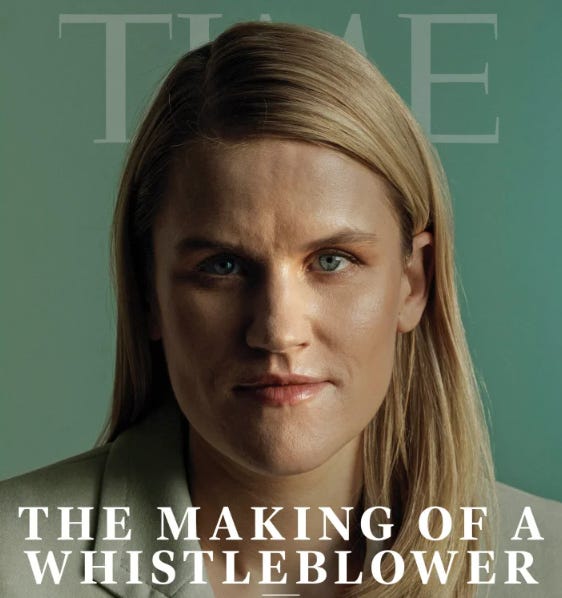
A former Facebook employee, Frances Haugen, released a collection of internal documents showing that Facebook deliberately creates widespread societal chaos to improve its bottom line. More chaos means more online traffic, and more traffic means more money for Facebook.
Beginning in late summer, Haugen, 37, disclosed tens of thousands of pages of internal Facebook documents to Congress and the Securities and Exchange Commission (SEC). The documents were the basis of a series of articles in the Wall Street Journal that sparked a reckoning in September over what the company knew about how it contributed to harms ranging from its impact on teens’ mental health and the extent of misinformation on its platforms, to human traffickers’ open use of its services.
The documents paint a picture of a company that is often aware of the harms to which it contributes—but is either unwilling or unable to act against them. Haugen’s disclosures set Facebook stock on a downward trajectory, formed the basis for eight new whistle-blower complaints to the SEC and have prompted lawmakers around the world to intensify their calls for regulation of the company.
Although many insiders have blown the whistle on Facebook before, nobody has left the company with the breadth of material that Haugen shared. And among legions of critics in politics, academia and media, no single person has been as effective as Haugen in bringing public attention to Facebook’s negative impacts.
Why did this whistleblowing take so long?
One answer is that blowing the whistle against a multibillion-dollar tech company requires a particular combination of skills, personality traits and circumstances. In Haugen’s case, it took one near-death experience, a lost friend, several crushed hopes, a cryptocurrency bet that came good and months in counsel with a priest who also happens to be her mother.
Haugen’s atypical personality, glittering academic background, strong moral convictions, robust support networks and self-confidence also helped. Hers is the story of how all these factors came together—some by chance, some by design—to create a watershed moment in corporate responsibility, human communication and democracy.
Examples of Bias
There have been multiple disturbing findings uncovered over the past several years and here are just a few:
In 2016, biased search results generated by Google’s search algorithm likely impacted undecided voters in a way that gave between 2.6 and 10.2 million votes to Hillary Clinton.
On election day in 2018, the “Go Vote” reminder Google displayed on its home page gave one political party between 800,000 and 4.6 million more votes than it gave the other party.
In the weeks leading up to the 2018 election, bias in Googles’s search results may have shifted upwards of 78.2 million votes to the candidates of one political party (spread across hundreds of local and regional races).
In the days leading up to the 2020 Presidential election and the 2021 Senate runoff elections in Georgia, there was extreme political bias on Google and YouTube (which is owned by Google), sufficient to have shifted at least 6 million votes in the Presidential election without people’s knowledge.
Google’s “autocomplete” search suggestions can turn a 50/50 split among undecided voters into nearly a 90/10 split without people’s awareness.
Google has likely been determining the outcomes of upwards of 25% of the national elections worldwide since at least 2015.
But what about Russia?
Some will argue that significant influence has and continues to be undertaken by nation states (e.g. Russia) that are hostile toward U.S. interests. However, the Russian interference, although troubling and unacceptable, can shift only a handful of votes (in a national election, perhaps tens of thousands at most. Compare this to Google and their gang that can easily shift millions of votes especially if they all support the same candidate or party (which they tend to do).
References:
Googles Triple Threat by Dr. Robert Epstein, PhD.
###