

The Fine Tuning Argument
Evidence for extreme fine-tuning grows as science advances and an increasing number of perfect calibrations are now understood to enable the perfect environment required for human life on earth.

The "Fine-Tuning" Argument
Once upon a time it was possible to believe that life could exist anywhere in the universe, and we assumed that life probably existed on many planets. That's because we believed that the conditions for life were not difficult to meet. And since there were so many stars and planets, it only followed logically that there must be plenty of life out there.
In fact, in the year Time published its famous cover story, the astronomer Carl Sagan said there were only two criteria required for life to exist on any given planet. One was having a star something like our sun, and the other was being the right distance from that star. Since those two conditions were so easy to meet, there must be literally billions of planets in the universe that could support life.
Given this now very primitive understanding of how easily life could emerge from non-life in such places, Sagan confidently calculated that there should be innumerable planets with life. This kind of thinking— coupled with Star Trek on TV every week—led to the widespread idea that a colorful variety of life existed throughout the universe. And it was only a matter of time before we found it. Or it us.
Not long after Sagan made his bold pronouncement, however, subsequent scientific discoveries made it increasingly untrue. The more science learned about the conditions necessary for life, the more it found new criteria that were just as vital as the two Sagan had mentioned. Eventually there were dozens, and the more science learned the more there were. So of course the probability of life in the universe plummeted drastically from billions of planets "probably" having life down to millions and then to thousands. Every time another condition was discovered that was necessary for life, it mathematically reduced the number of planets down until the conditions mounted so high that the number of planets that might support life was winnowed to almost nothing.
Eventually, the conditions science reckoned necessary for life had risen so high that the idea that life existed anywhere at all— as it obviously did on our planet-seemed more and more miraculous, and then even outlandish. It didn't make sense that we existed. And yet here we are. What to make of it?
It seemed that the only rational answer for our existence was that everything in the universe had been intentionally designed so that life here could exist.
One of the simplest examples of the fine tuning argument has to do with the size of our planet.
We now know if our own Earth were any bigger or smaller, life here could not exist. This is only one of the parameters we have discovered as necessary for life, but it's a good place to begin.
The first question must be why the size of a planet would have anything to do with whether life could flourish, and the first and simplest answer has to do with our magnetic field. Who ever thinks about Earth's magnetic field? But it happens nonetheless to be magnificently important in many ways.
If Earth were any smaller, our magnetic field would be weaker, and what we call the "solar wind" would quickly strip our atmosphere down to almost nothing, so that we would end up like Mars, which is of course a lifeless world. And who thinks about the solar wind? But if we did, we would realize that it is a stream of charged particles-"ion gas" or plasma-made up of electrons, protons, and some alpha rays blasted toward us every moment from the sun. But because of the size of our planet, our "magnetosphere" is just powerful enough to protect us from that radiation.
The magnetospheres of the gigantic planets Jupiter and Saturn are also very powerful. And just as happens here on Earth, their magnetospheres deflect the solar wind so that it travels mostly around them instead of to their surfaces. Here on Earth, the solar winds would have long ago stripped away our hydrogen and oxygen, which of course make up water, which could hardly be more important. Mars is not much smaller than Earth, but it is just small enough that its magnetosphere cannot protect it, and as we have said, most of its atmosphere was stripped away eons ago. This is just one aspect of the fine-tuning of Earth's environment, illustrating how little it would take for life here to be impossible. But it's a fact that if Earth were slightly smaller, there could be no life here.
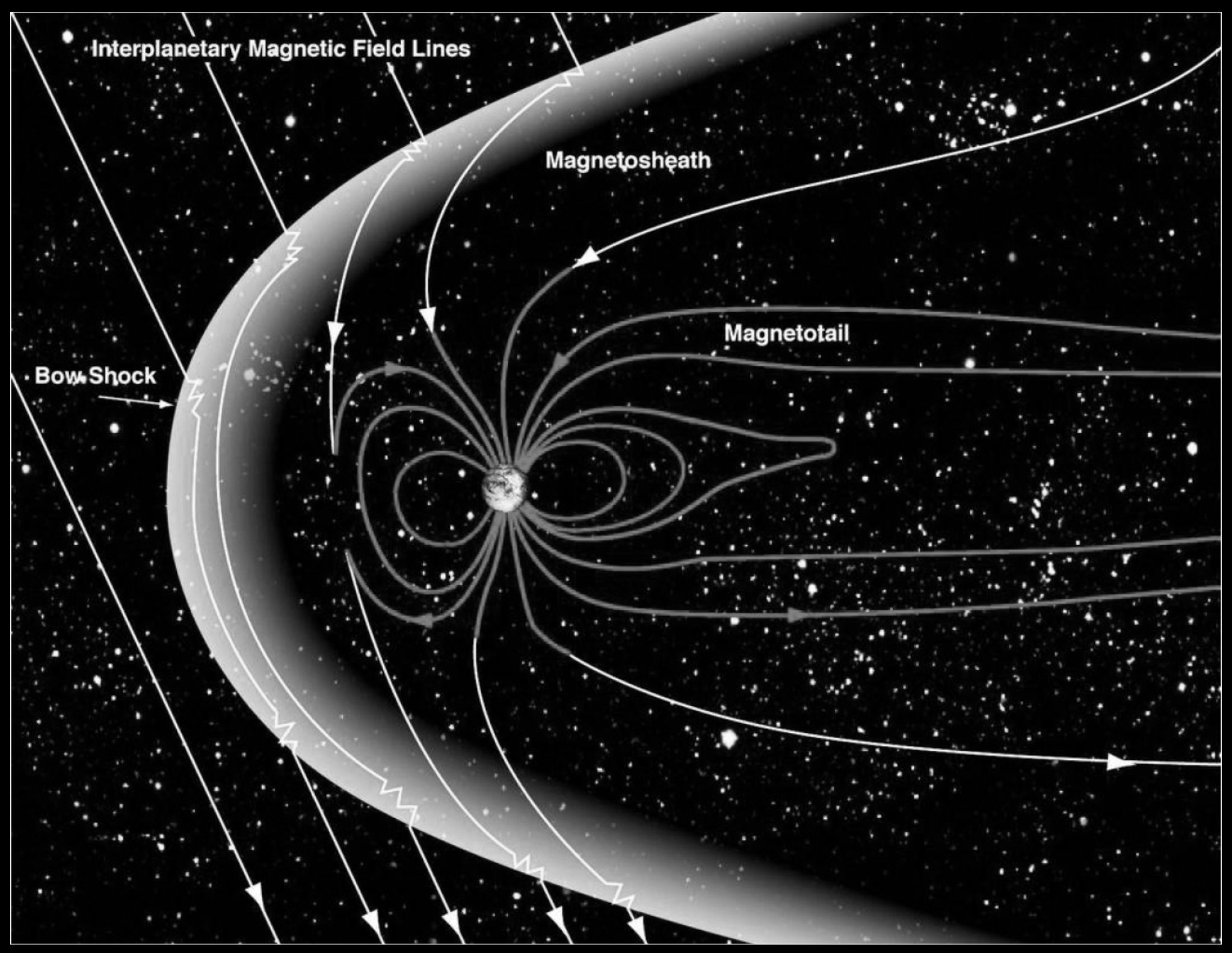
Structure of the Earth's magnetosphere. NASA
But if Earth were any larger, we would have other life-killing problems. In their book The Privileged Planet, authors Guillermo Gonzalez and Jay Richards explain that a larger Earth would have more powerful gravity, so that no water or methane or carbon dioxide could escape our atmosphere, which would be so thick we couldn't breathe. Our air would be more "viscous." According to Gonzalez and Richards: "Earth may be almost as big as a terrestrial planet can get." Again, who would ever think that the size of our planet would be so precisely and perfectly calibrated for life? That if it were even slightly smaller or larger there could be no life whatsoever?
But the more science learns, the more we see that the science fiction scenarios we have grown up with are hopelessly out of date and have confused us into believing that the conditions for life on any given planet can vary dramatically. But now we know that they cannot.
❤️❤️❤️